
From Stealth to $30 Billion: The VAST Data Journey
By Greenfield Partners
VAST Data just closed a Series F financing at a $30 billion valuation, making it one of the most valuable private technology companies to ever come out of Israel.
VAST has built the platform that powers modern AI infrastructure - the system responsible for storing, organizing, and continuously feeding data into large-scale compute systems, from model training to real-time inference and agent-driven workloads. As AI has scaled, the bottleneck in computing has shifted from compute itself to data movement, and VAST sits at the center of that transition.
Its platform now underpins some of the world's most demanding AI environments, from CoreWeave's global GPU cloud to Mistral AI's frontier model training, supporting over 25% of the Fortune 100 and AI deployments spanning millions of GPUs worldwide.
We first backed VAST Data in 2019, leading the Series B when the company emerged from three years of stealth with a bold thesis about the future of data infrastructure. Since then, we've been fortunate to be able to double and triple down on VAST as the company has executed on its bold vision.
This is the story of what we saw, what VAST built, and why we believe the company's most important chapter is still ahead.
For decades, enterprise systems were designed for humans querying data - intermittently, sequentially, and at relatively modest scale. AI changes that completely. Instead of a small number of users accessing data occasionally, modern systems must support thousands of machines continuously consuming and processing data in parallel - at a level of scale and concurrency traditional architectures were never designed to handle.
What the Storage Market Looked Like in 2019
To understand why VAST Data matters, you have to understand the world the founders set out to change.
For thirty years, enterprises had been trapped in a painful tradeoff: fast storage was expensive, and cheap storage was slow. The entire industry was organized around this compromise. Data was tiered across multiple systems, each optimized for a narrow use case, none designed to work together. The complexity was staggering.
This wasn't a problem anyone thought could be solved. It was just the way things were.
Renen Hallak, VAST's founder and CEO, saw it differently. As the first engineer and eventual VP of R&D at XtremIO, the all-flash startup that became Dell EMC's flagship flash storage platform, Renen had spent years building within the existing paradigm and understood its limitations at the deepest level. But his ambition wasn't to build a better version of what already existed. It was to ask a more fundamental question: with new hardware now available, what architecture would you design from scratch?
Together with co-founders Shachar Fienblit, Jeff Denworth, Alon Horev, and Avi Goren, Renen spent nearly three years in stealth building the answer. What they built was more than a storage product. It was a new architectural foundation; one designed from the ground up to eliminate the compromises that had defined the industry and to serve as the data layer for a fundamentally different future.
Why We Backed VAST
When we evaluated VAST in early 2019, what struck us first was the ambition. Renen didn't describe VAST as a storage company. He described it as a data platform company, one that would start by solving the storage problem at its root and then build upward toward a unified system where all of an organization's data could be accessed, enriched, and acted upon in real time. Storage was the wedge. The platform was the vision.
That kind of thinking is exactly what we look for. But vision alone doesn't make an investment. We needed to understand whether the product could deliver.
So we did what we always do: we spoke with customers. At the time, the company was just coming out of stealth and there were only a handful of prospective customers, each evaluating large potential deployments that would represent significant contracts if they chose to move forward. They were running POC deployments to test the product. We expected early, tentative feedback. What we heard was something else entirely, and it was consistent across the board. "Forget the POC, VAST is already running live in production." "VAST is a game-changer."
For a company that hadn't even publicly launched, that kind of customer conviction was extraordinary. It told us this wasn't a science project. It was a product that was quietly solving real problems at scale before the rest of the market even knew it existed.
We backed the company based on three convictions:
The team was singular. Renen, Shachar and the team had built and operated storage systems at the highest level. They carried the scars and the lessons of the prior generation, and the ambition to rebuild the entire category from first principles. That founding team has stayed intact through the entire journey, which is itself a rare and powerful signal.
The architecture was a genuine paradigm shift. VAST wasn't iterating on existing designs. They had built an entirely new distributed systems architecture they call DASE - Disaggregated Shared Everything - the first true parallel distributed system architecture designed to eliminate the longstanding tradeoffs between scale, simplicity, performance, and cost. Every node could access every piece of data without coordination overhead. This fundamentally removes data locality as a constraint, allowing thousands of machines to access the same dataset simultaneously (now a requirement for modern AI workloads).
The vision extended well beyond storage. Even in 2019, the VAST team was building for a future in which the volume and velocity of data would demand fundamentally different infrastructure. They saw that the world's most data-intensive workloads, from deep learning to genomics to quantitative finance, were only going to grow in scale and complexity. The right data foundation, built now, would become the critical platform for whatever came next.
Growth That Defied Convention
What followed was a growth trajectory unlike anything in the history of enterprise data infrastructure.
The numbers speak for themselves. VAST has surpassed $4 billion in cumulative bookings and exited its most recent fiscal year with more than $500 million in Committed Annual Recurring Revenue, alongside positive operating margin and positive free cash flow. In that same year, VAST delivered a Rule of X score of 228%, a metric that combines growth rate and profitability into a single measure, and at 228% reflects a pairing of hypergrowth and durable economics that has effectively no parallel in enterprise infrastructure.
Equally striking has been the capital efficiency. VAST's combination of high average selling prices, exceptional net revenue retention, and a lean operating model produced a business that grew at record pace without burning capital. As the company itself has put it: growth and efficiency have never been a tradeoff at VAST, just as performance and affordability are no longer a tradeoff in their product.
These aren't just impressive numbers. They're the signature of a company that found deep product-market fit with an architecture that solved a problem customers had been waiting decades to have solved.
From Storage to the AI Operating System
If the first chapter of VAST's story was about building the world's best data foundation, the next chapters have been about realizing the broader vision that was always the plan.
VAST began expanding beyond storage into a unified data platform, adding a native database that spans transactional, analytical, and vector workloads, a serverless compute engine that runs functions directly where data lives, and a global namespace that unifies data silos across environments. Each layer was built natively on the same underlying architecture, not bolted on through acquisition.
The significance of this evolution is not just integration, it is simplification. Historically, each layer of the data stack existed because the one below could not keep up. Once data can be accessed universally and at high throughput, those layers can collapse into a single system. What VAST is building is not a collection of features, but a rethinking of how the entire data stack is organized.
As AI workloads began to scale, it became clear that the architecture VAST had built was not just relevant; it was precisely aligned with the emerging demands of the new computing paradigm. As massive GPU clusters emerged as the engine of a new computing paradigm, the infrastructure demands they created were exactly the kind of problem VAST's architecture was designed to solve. Feeding hundreds of thousands of accelerators with data at scale, without bottlenecks, without tiering, without compromising on cost or complexity, required the foundation VAST had spent years building. The company didn't need to pivot or retrofit - the architecture had been designed with this trajectory in mind.
By 2025, VAST unveiled what it now calls the AI Operating System, a full-stack software platform that integrates data ingestion, real-time retrieval, AI pipeline automation, and agent orchestration into a single system. The platform today powers some of the most consequential AI deployments in the world. From CoreWeave's global GPU cloud to Mistral AI's frontier model training, from JPMorgan Chase and Adobe in the enterprise to Lowe's in retail and the U.S. Air Force in government, alongside AI-native companies like Cursor.
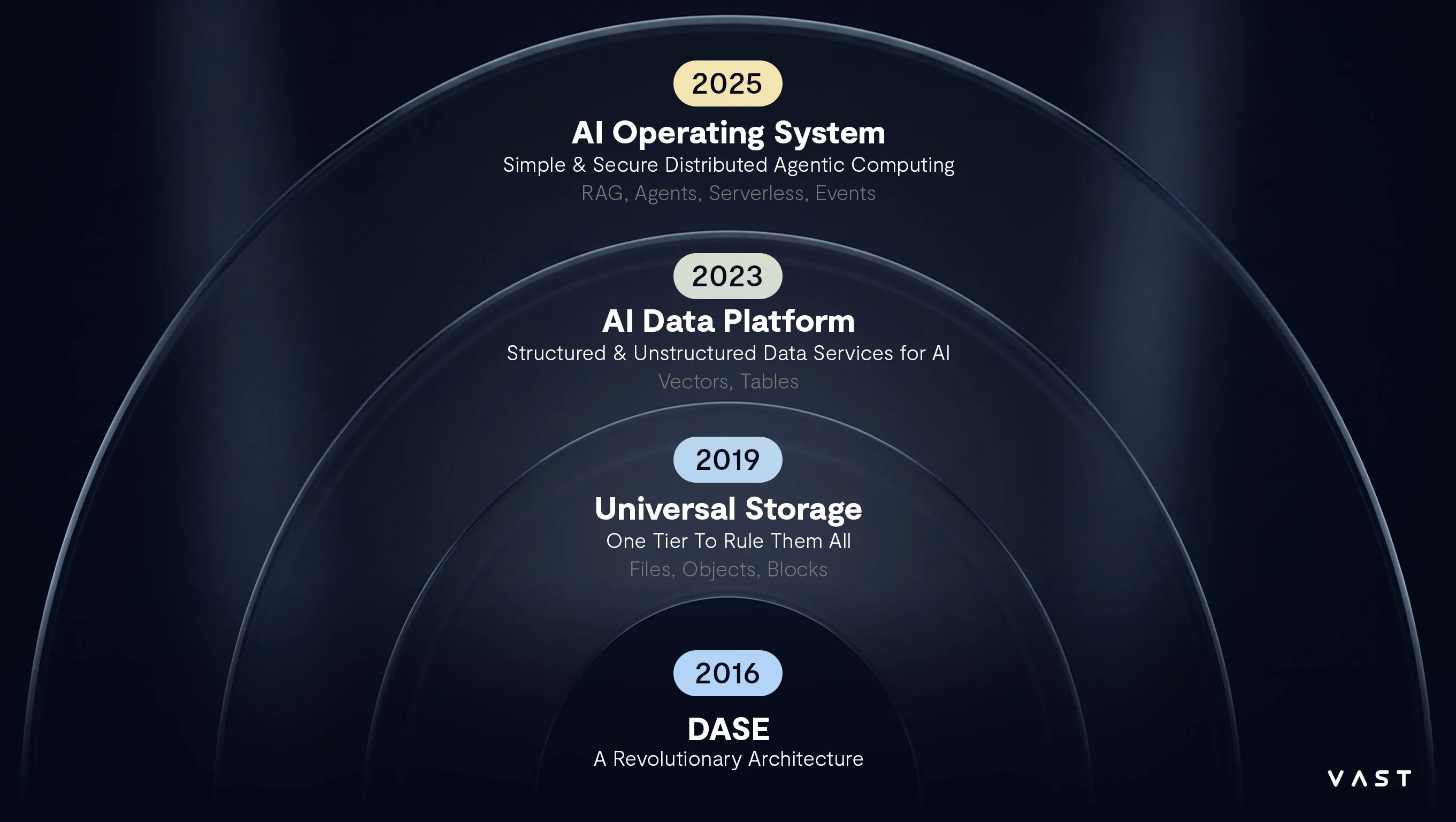
The evolution of the VAST Data Platform
Today, the VAST AI Operating System sits at the center of this transformation, unifying data, compute, and real-time processing into a single system. What were previously separate layers of the infrastructure stack are increasingly converging around a unified data foundation.
The evolution from a storage company to an AI operating system company wasn't a pivot. It was the roadmap. Storage was always Act One, the critical foundation that had to be built first. What VAST is building now is the system that sits between raw data and intelligent applications, making it possible for AI to learn, reason, and act on the full breadth of an organization's information in real time.
Why We Kept Investing
At Greenfield, we think a lot about conviction, not just at the moment of initial investment, but at every stage that follows. VAST is the clearest expression of that principle.
We invested in 2019 when the company was just emerging from stealth. We continued to back VAST through multiple investment rounds along the way. At each stage, we asked the same question: is the thesis growing apace with the company's advancement in a credible manner? With VAST, it was the case each time. The storage thesis became a data platform thesis, which became an AI infrastructure thesis, which became an AI operating system thesis. Each layer of ambition was validated by accelerating adoption, deepening unit economics, and a product roadmap that consistently anticipated where the market was heading next.
Backing VAST has been a reminder of what conviction looks like when it compounds, and what happens when a world-class team executes against a first-principles vision with discipline and patience.
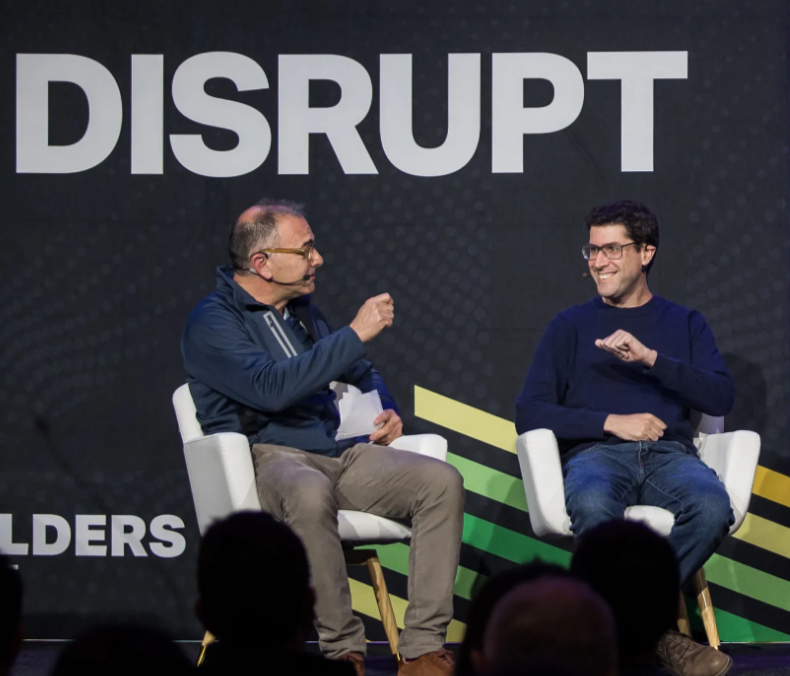
Renen Hallek at with Shay Grinfeld at Greenfield Partners' AI Disruptors 60 | TechCrunch Disrupt 2025
What Lies Ahead
Today, VAST Data has over 1,000 employees, offices spanning New York, Tel Aviv, Tokyo, Singapore, Riyadh, and Dubai, and a customer base that includes the organizations building the AI-powered future.
But what excites us most isn't the milestone VAST has reached. It's the size of the opportunity still ahead. The AI industrial buildout now underway is approaching trillions of dollars in scale, spanning AI factories and the software systems that run them.
The data layer, where VAST operates, is the critical bottleneck that determines whether those GPU investments translate into scalable, efficient systems - or are ultimately limited by the cost and complexity of moving data.
At scale, that limitation shows up not as a single failure point, but as a compounding effect: underutilized compute, increasing system complexity, and rising costs that make it progressively harder to turn infrastructure into real-world performance.
In the most demanding AI environments - large-scale training, GPU clouds, and enterprises building their own AI infrastructure - the need for a new data architecture is already non-negotiable. Feeding thousands of accelerators with data at scale, without bottlenecks, is not something legacy systems can support, which is why VAST has become the system of choice in these environments.
In addition, as model APIs become more powerful and widely adopted, they further shift the center of gravity toward the data layer. While compute becomes increasingly abstracted, the complexity of storing, preparing, retrieving, and continuously serving proprietary data only grows, making the data foundation the defining constraint in real-world AI systems.
VAST has built the operating system for that data layer, and as AI systems become more continuous, more data-intensive, and more interconnected, the importance of that layer only compounds.
VAST Data's journey is a testament to what happens when exceptional founders pursue a contrarian vision with patience, rigor, and relentless ambition. We're proud to have been their partners from early on. And we believe the most important part of this story is still being written.
Greenfield Partners is a global early growth investor managing over $2 billion in assets. We partner with exceptional teams building category-defining technology companies. Learn more at greenfield-growth.com.