
AI is everywhere in Go-to-Market.
It is now embedded across nearly every part of the revenue organization, from prospecting to deal management. At the task level the impact is most obvious: work that used to take 30 minutes can now take five.
Given the huge advancements in frontier AI, I would have expected a step-function improvement in GTM productivity by now: shorter sales cycles, lower CAC, more opportunities per rep, and, above all, more ARR per rep.
Yet in the dozens of companies I interact with, I keep seeing many of the same GTM challenges. AI has made many tasks easier, but it hasn't made the fundamental challenges of building and scaling a GTM organization disappear.
That doesn't mean AI isn't working. It suggests something more interesting:
Making individual tasks faster is not the same as making the organization more productive.
If an AE saves 25 minutes preparing for a meeting but finishes the year generating roughly the same ARR, we've gained efficiency - but very little of it has translated into business productivity.
So what does it take to turn AI adoption into real GTM productivity?
I believe four principles matter most.
1. Start with the Outcome, Not the AI
Don't start by asking where you can deploy AI. Start with the business outcome you want to improve, and work backwards.
If discovery conversion is too low, understand why. Are reps talking to the right buyers, uncovering meaningful pain points, and qualifying opportunities effectively?
Define what better execution looks like, then determine where AI can improve or scale it - and measure whether the KPI actually moves.
AI implementation should start with a business outcome and a process to improve, not an AI capability to deploy.
2. Build the Playbook Before You Scale It
AI needs a strong process to operate within.
That process starts with your GTM fundamentals - who you sell to, the value you create, and how your best teams sell. Those fundamentals should be translated into playbooks that define the objective, the context AI needs, the workflow, and how success is measured.
Importantly, AI doesn't have to create the playbook.
Great GTM processes are built from experience, customer understanding, company knowledge, and data. AI can help develop and improve them, but it is not a substitute for doing that work properly.
If the underlying process is mediocre, AI will execute a mediocre process faster, and at greater scale.
3. Use AI to Raise the Floor
Every sales organization has people who consistently outperform.
You can't simply clone your best reps, and AI won't magically turn every salesperson into one. But you can study what your top performers do differently, combine those insights with your broader GTM best practices, and encode what is repeatable into your playbooks.
AI can then help make that standard more consistent across the organization - from meeting preparation and discovery to qualification and deal execution.
Evidence from outside sales supports this mechanism. In a study of more than 5,000 customer-support agents, AI increased productivity by about 14% on average, but by roughly 34% among less experienced workers - consistent with AI spreading the practices of stronger performers.
That points to what may be one of AI's biggest opportunities in GTM:
AI can help move the performance of the entire organization up - by helping the average salesperson operate closer to the standard of the best.
It's not just about raising the ceiling.
It's about raising the floor.
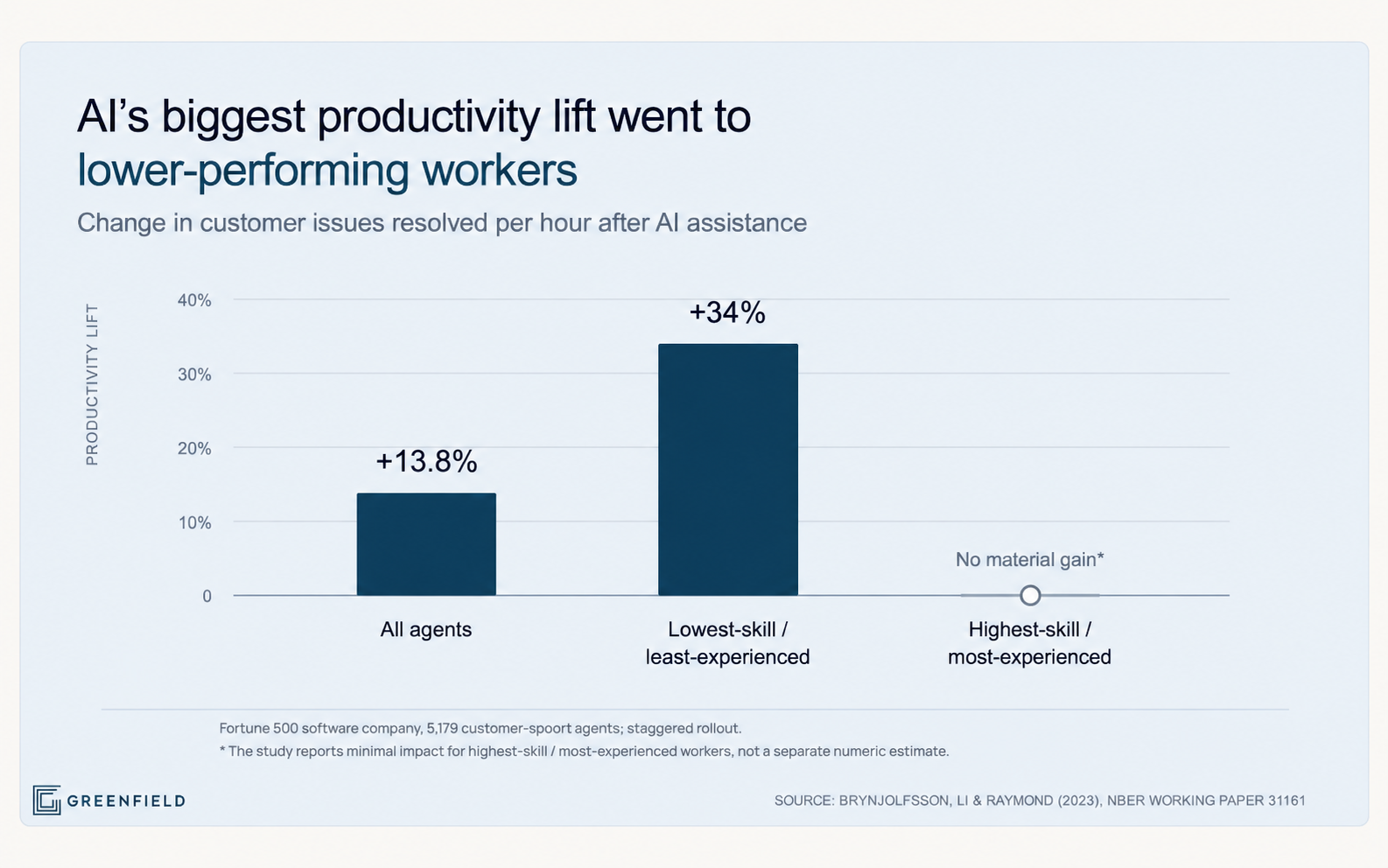
AI productivity lift by worker experience
4. Close the Feedback Loop
Once the playbook is tied to a clear KPI, AI can help us understand what is actually working.
Which behaviors correlate with progression? What patterns appear in wins? Where are deals consistently breaking down?
Those insights can feed back into the process and continuously improve the playbook.
GTM Fundamentals > Best Practices > Playbook > AI Execution > KPI > Feedback > Improved Playbook
AI helps execute the process, learn from the results, and over time improve the process itself.
That's when the value starts to compound.
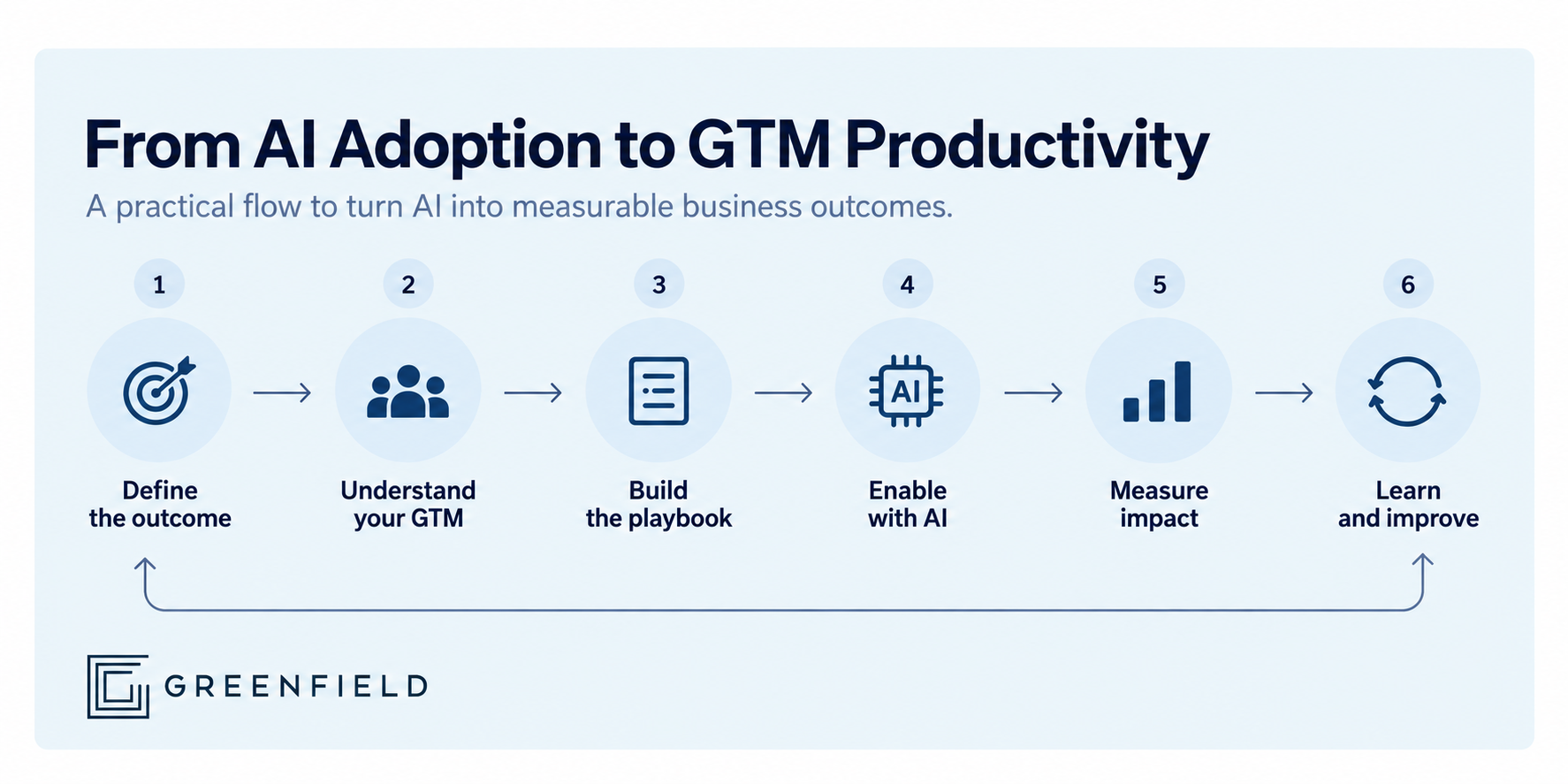
From AI adoption to GTM productivity
From AI Adoption to GTM Performance
The first phase of AI in GTM has largely been about increasing efficiency and optimizing workstreams.
We added AI across the revenue organization and made every part of it more efficient.
We didn't necessarily redesign the machine.
I believe the next phase should be different: start with the business outcome, build the right playbooks, give AI the context it needs, and use it to make great execution more consistent while continuously improving the playbook.
AI should not replace GTM expertise - It should help scale it.
If we get that right, we can help the average rep perform closer to the level of our best reps and build a GTM organization that continuously improves as it operates.
The goal isn't AI that helps reps do more.
The goal is AI that makes the GTM organization perform better.