


The U.S. and Europe are at the dawn of a new industrial age. Rockets are flying at record cadence. Autonomous drones are being fielded at scale. Humanoid robots are entering factory floors. The defense and space sectors are spending at levels not seen since the Cold War. A generation of founders - many of them veterans of SpaceX, Anduril, and Palantir - are treating physical systems the way the last generation treated software: as a domain ripe for reinvention.
And most of them are waiting six months for components.
That gap - between the ambition of the hardware being designed and the reality of the supply chain being asked to build it - is a major constraint of this industrial moment. And it is also, for the founders who recognize it, one of the most interesting opportunities to innovate in.
The Wave - and the Gap It Exposed
The new builders - in defense, space, autonomy, and robotics - share a set of demands the old supply chain was never designed to meet. They move like software companies, shipping new versions in months and expecting parts in days - when a supplier's lead time is longer than an engineering sprint, the supplier becomes the bottleneck. The parts themselves are not commodities: special materials, tolerances measured in microns, shapes only advanced fabrication can produce. And demand doesn't ramp predictably - a single contract win can take a drone program from 50 units to 50,000 in months, with suppliers expected to multiply output without restarting a year-long qualification process. Layer on ITAR rules and national security requirements that have turned "made in America" from a preference into a hard requirement, alongside a broader need for trusted Western manufacturing. The mismatch is stark: 30 years of offshoring stripped out exactly the factories, supplier ecosystems, and process knowledge this moment demands.
But what makes this moment different from previous calls to reshore is that the tools to rebuild have never been better. The same AI, robotics, and simulation software powering next-gen drones and robots can be turned inward, toward the factory floor: a CNC machine that programs itself from a CAD file, a factory that ships a qualified assembly in two weeks instead of six months, a forming cell that replaces an entire die shop with two robots and a software model. The deeper shift is where knowledge lives. Traditional manufacturing encoded it in people - and it left when workers retired or factories moved offshore. The new model encodes it in software, making manufacturing reproducible, transferable, and improvable the same way code is.
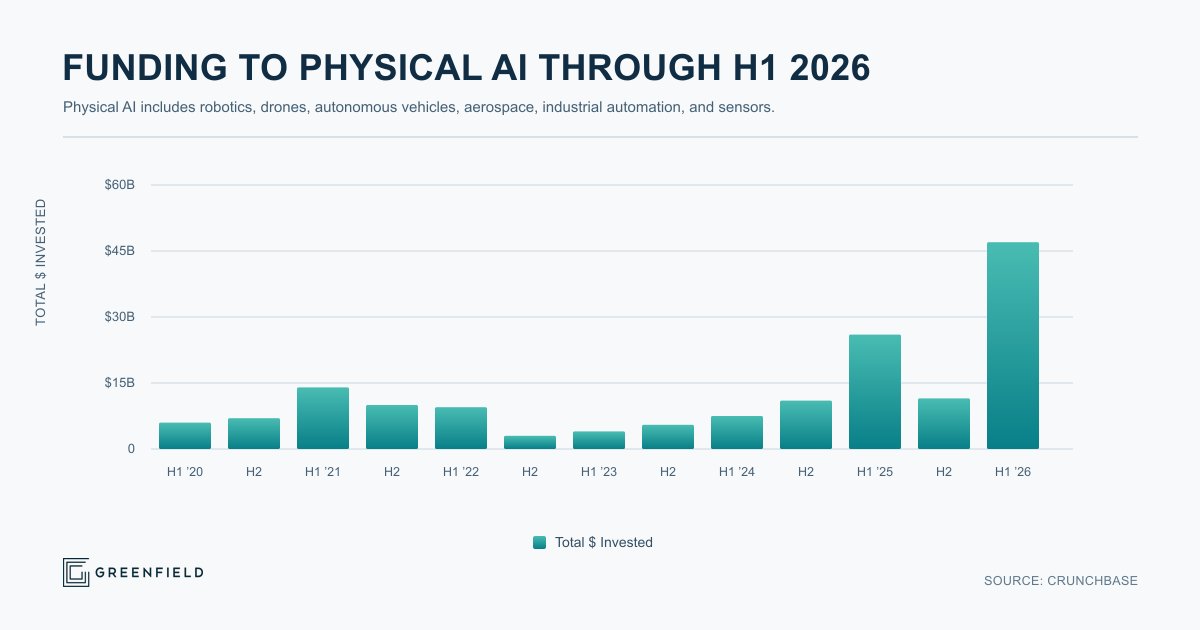
Physical AI is not just the demand driving the supply chain crisis - it is the technology enabling its solution. The hardware renaissance and the manufacturing innovation opportunity are the same story.
The Reindustrialization Value Chain
Rebuilding from scratch requires work across four distinct layers.
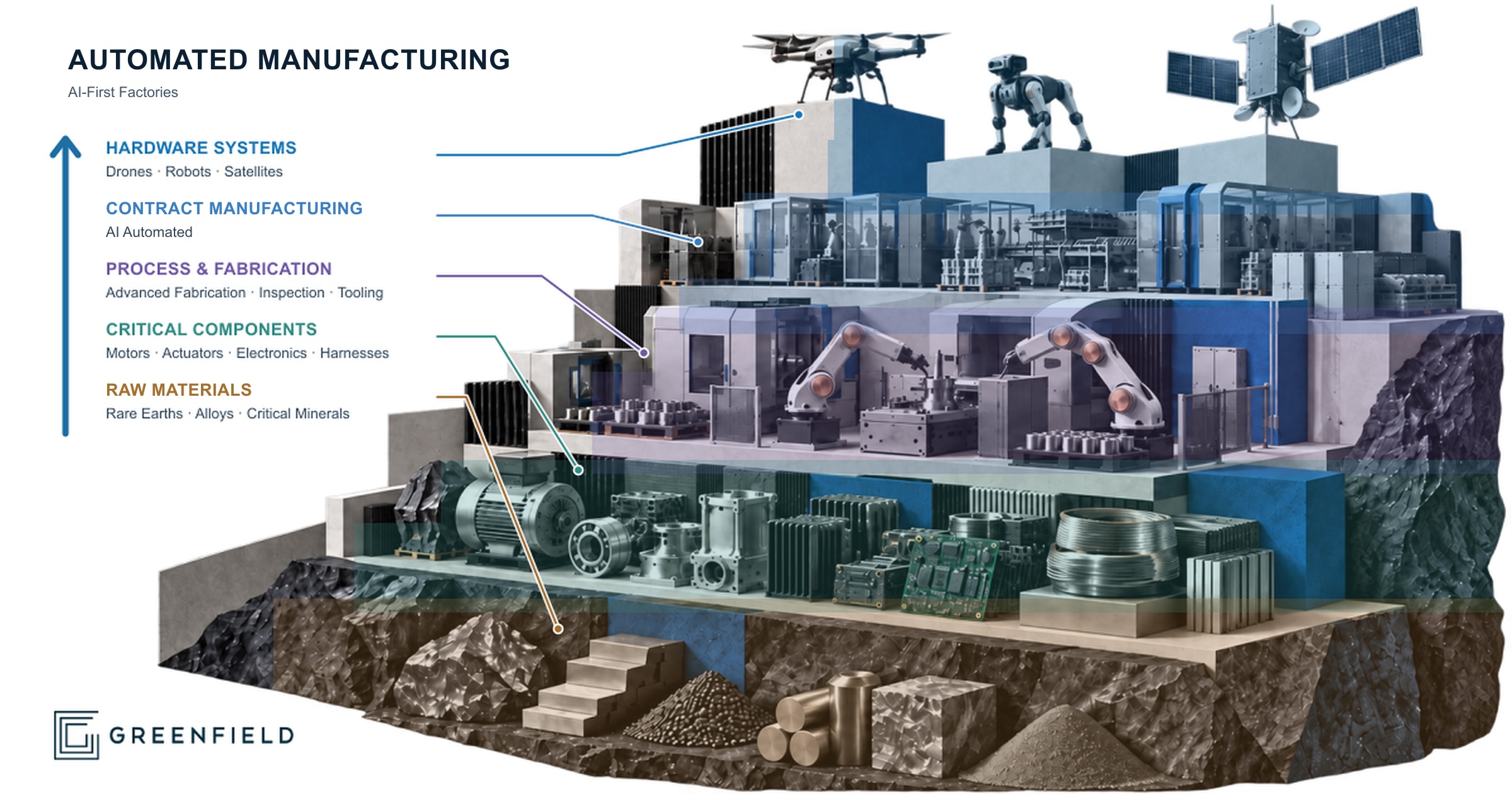
The first layer is contract manufacturing. A new class of software-driven, highly automated contract manufacturers is emerging to replace the legacy job shop model. Rather than rolling up old shops to extract incremental efficiency, these companies are building from scratch - encoding manufacturing process knowledge in software, leveraging robotics to run machines autonomously, and compressing quote-to-part timelines from weeks to days. The best versions will look like vertically integrated production infrastructure with real control over quality, capacity, and delivery.
The second layer is process and fabrication technology. Traditional manufacturing methods were designed for either mass production or skilled manual labor - neither maps well onto the high-mix, high-complexity, lower-volume demands of the new hardware wave. A new generation of companies is rebuilding the process layer: AI-driven metal forming that eliminates tooling, industrial-scale additive manufacturing for mission-critical parts, composite procurement platforms that compress weeks of sourcing into hours. What these companies share is a bet that the goal isn’t just cheaper production - it’s production that learns. Every build, every inspection, every qualification cycle can improve the factory, the same way software improves with every user interaction.
The third layer is critical components - and it may be the most important. The U.S. and Europe currently produce too few of the motors, actuators, wire harnesses, ball screws, and subsystems that physical systems depend on at scale. These components sit inside every drone, every robot, every autonomous vehicle, and even every reclining airplane seat. A hardware company can have world-class software and engineering - but if its component supply chain is constrained, foreign-dependent, or fragile, the business is too. This is where supply chain resilience becomes product advantage, and where the production gap across the West is most acute.
The fourth layer is critical raw materials. Every layer above ultimately rests on physical inputs - rare earth elements for the magnets inside motors, specialty alloys for structural parts, critical minerals for batteries and electronics. The West remains dependent on external sources for many of them. China controls the majority of global rare earth refining capacity, which means even a fully domestic motor or actuator can still sit on top of a foreign-controlled input. Reshoring the supply chain across the West is incomplete if the materials at the bottom of it remain single-sourced abroad. A new set of companies is working to mine, refine, and recycle these inputs across the U.S. and allied countries - the deepest and least substitutable chokepoint in the entire stack.
Closing Thoughts
Startups rebuilding the industrial base are tackling one of the largest and most consequential opportunities in technology today. The drones, robots, satellites, and defense systems that will define the next decade are only as capable as the supply chain underneath them, and a country that cannot make its own motors, magnets, and circuit boards cannot ultimately field its own hardware - no matter how brilliant the software sitting on top. The stakes here are at once economic, strategic, and national.
And for the first time in a generation, the conditions to win are aligned: surging demand, a hard-won recognition that the old supply chain has failed, and a set of technologies finally powerful enough to rebuild it from the ground up. The founders who take this on are not just starting companies - they are re-establishing the ability of America and its Western allies to make things, and with it the industrial base that the next generation of innovation will be built on.
That is a rare kind of opportunity, the kind that comes along once in a generation. The new industrial age is real and accelerating. The only question left is who builds the foundation beneath it.