

The Pressure Beneath the Surface
Over the past few years, the same question has surfaced repeatedly across policy debates, boardroom discussions, and supply chain disruptions: can we actually keep making the things we depend on?
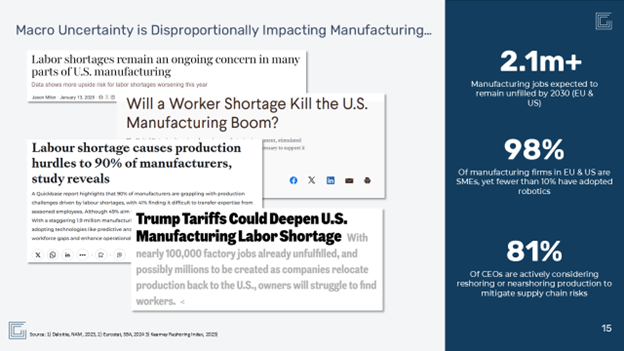
Production has been moving closer to home, and resilience has begun to matter more than efficiency. At first glance, this looks and feels like a geopolitical shift. Beneath it sits something more fundamental: if manufacturing is going to localize and persist, the system supporting it must absorb far more strain than it does today. What we found instead was a system already stretched thin.
Manufacturing in the West is vast but deeply fragmented. Most factories are small or mid-sized, quietly embedded in supply chains, doing essential work that rarely attracts attention but keeps entire industries moving. Many are well run, often family-owned or regionally anchored, yet almost all operate with limited automation, tight margins, and little tolerance for disruption.
For decades, labor absorbed this complexity. When demand shifted, people adapted; when processes failed, people compensated. But repetitive factory work has become less attractive to younger generations, while experienced operators are retiring faster than they can be replaced. In the EU and US alone, more than two million manufacturing jobs are expected to go unfilled by 2030. What once bent under pressure is now beginning to crack.
The technology to automate exists and in controlled environments it works well. But those environments share a common profile: stable production, long runs, dedicated engineering teams, and the ability to plan years ahead. Most factories don't look like that. Traditional industrial robots are expensive, slow to deploy, brittle, change the product, the layout, or the volume, and the economics unravel. For most manufacturers, automation has become something to work around, rather than rely on.
This is the core problem: when automation only works for ideal, large-scale factories, the rest of the manufacturing base becomes structurally fragile. And that fragility, not tariffs, not policy, not capital, is the binding constraint on reshoring and resilience.
Built in Munich
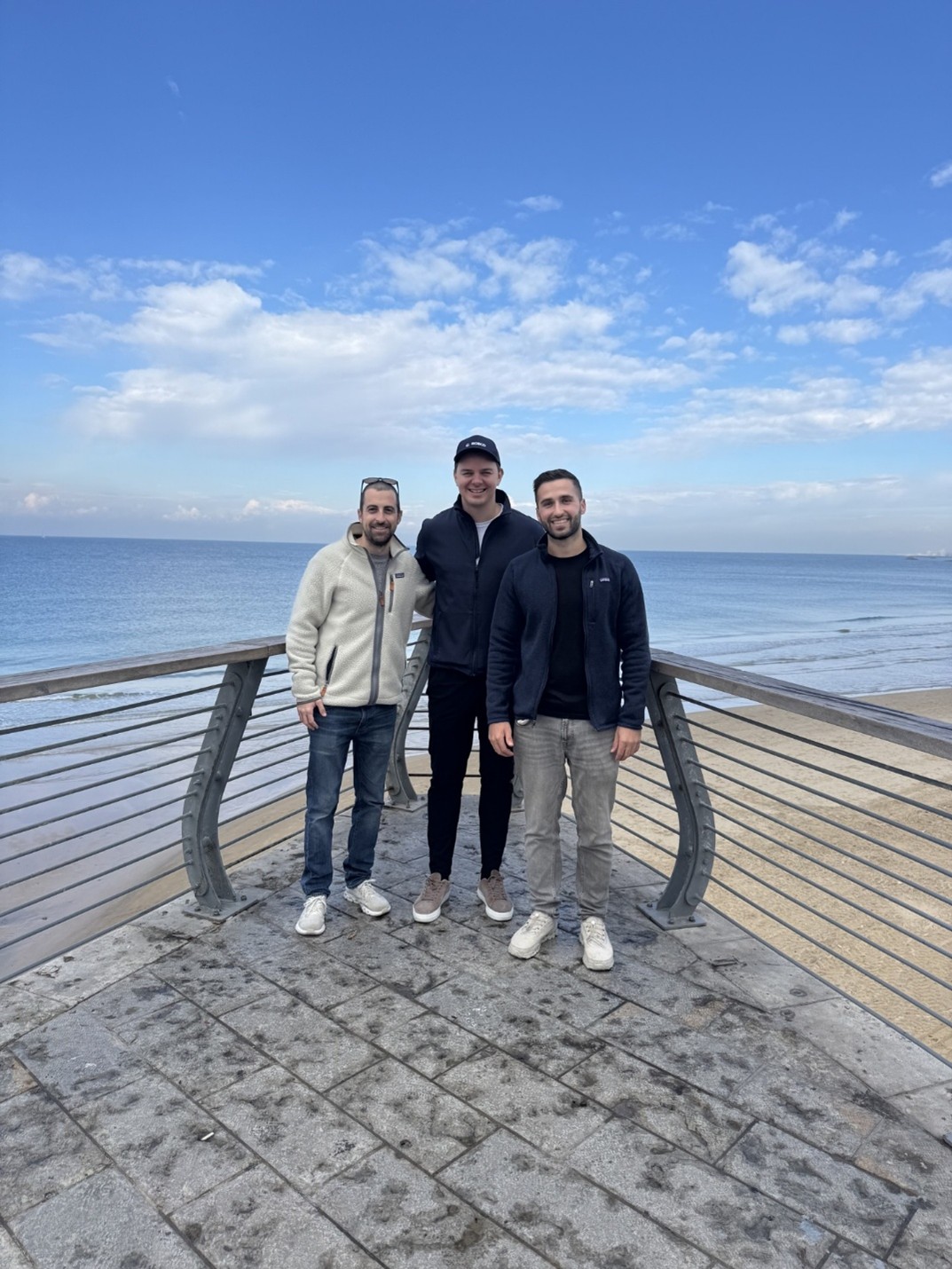
It was a cold morning in Munich when we first visited RobCo in person. We had met Roman, the CEO, over Zoom a few weeks earlier, a call that started the moment he noticed a kitesurfing board leaning against our office wall. The conversation quickly turned to extreme sports, discipline, and knowing exactly where the edge is. Standing outside their office that morning, watching engineers bike past and factories already running their shifts, we could feel how that mindset shaped the company. Munich has been a manufacturing city for generations, and technology earns its place here by being useful.
Walking through the space, you see execution in real time. The final assembly workshop, where robots undergo last-mile quality checks before shipping, sits at the center. Engineers, sales, and operations work meters from the production line, with robots being built, tested, and shipped while decisions happen around them.
RobCo was founded by Roman together with Paul, who leads technology, and Constantin, who leads product. All three met during their PhDs at TUM. Long before launching the company, they were testing early systems in real factory environments, publishing research on digital twins in Science Robotics, and receiving continuous feedback from operators. That exposure shaped a lot of what followed.
The goal was never to build the most impressive robot, it was to make automation something factories could realistically deploy and depend on. When Roman talks about manufacturing, he sounds like an operator: focused on changeovers, reliability, and what breaks at 2 a.m., not what demos well. That perspective lives within the product.
.jpeg)
We saw it in customer deployments. RobCo's robots operate alongside traditional industrial systems, but when requirements change, they're often the first to be reconfigured. Issues that would typically mean days of downtime are resolved remotely within hours.
Inverting the Model
For decades, industrial robotics followed a familiar pattern: expensive hardware, system integrators, redesigned production lines, and specialists to keep everything running. When deployments failed, the conclusion was that the factory hadn't committed enough. That model was built for a different era, large, stable environments with predictable output and dedicated automation teams. It doesn’t work for the thousands of small, mid-sized, and increasingly large factories that underpin the $15 trillion global manufacturing industry. These factories are defined by high product mix, frequent changeovers, and limited engineering capacity.
RobCo decided to invert this. The system adapts to the factory.
RobCo has developed the full stack; fully vertically integrated hardware, software, deployment, and service, designed as a single integrated system.
What sets it apart is the architecture: four standardized modules that can be reconfigured for different tasks, kinematics, and payloads. It's less a robot than a platform. Deployment happens in days, and updates are delivered remotely. Every deployment is also a learning system. RobCo gets paid to improve, each robot in the field generates the operational data that makes the next deployment faster, more reliable, and easier to support. When issues arise, the team can teleoperate remotely, resolving problems in hours rather than days and capturing the exact data needed to ensure the same failure doesn't happen twice. The fleet gets smarter as it grows. And as AI capabilities advance globally, the operational data RobCo is collecting today becomes the foundation for increasing autonomy tomorrow. Replicating this requires not just better technology, but a fundamentally different way of building and operating a robotics company, one that incumbents cannot adopt without dismantling the integration-heavy model their economics depend on.
The timing also matters. Hardware costs continue to fall while AI capabilities advance rapidly. Labor shortages are structural. Reshoring is accelerating. For the first time, the economics and urgency are aligning. When automation becomes something a factory manager can deploy, adapt, and trust without calling an integrator, it stops being a capital project and starts behaving like infrastructure—budgeted like forklifts, expected to work.
RobCo's Robotics-as-a-Service model lowers barriers and aligns incentives. A factory that couldn't justify a six-figure capital expenditure can now deploy automation for a few thousand dollars a month. Payback is measured in months, and when the business changes, the system changes with it. RobCo started with small and mid-sized manufacturers, but the same flexibility that serves them has pulled larger customers. When flexibility becomes a constraint rather than a nice-to-have, the platform scales up as easily as it scales out.
The industry spent years waiting for automation to be perfect before it could be useful. RobCo inverts this: useful now, better tomorrow. The robots don't need to be flawless on day one.They need to work well enough to earn their place and improve from there. Their goal is to take on the repetitive, physically demanding work that is hardest to staff, freeing humans for tasks that require judgment. As Roman puts it, the goal is to automate the ordinary so humans can do the extraordinary.
Scaling from Munich to the World
RobCo has deployed hundreds of robots across ten countries in demanding production environments. The commercial traction, for what has been a historically challenging market, has been exceptional. 2025 marked a breakout year, with ARR growth and bookings that exceeded our expectations at this stage. The US expansion is particularly compelling, with offices in San Francisco and an assembly facility in Austin, RobCo is positioning itself at the center of the reshoring wave, and initial customer momentum suggests a massive opportunity still ahead.
We are proud to partner with RobCo alongside leading investors, Lightspeed, Sequoia, Kindred Capital, and The Friedkin Group, as well as strategic partners Lingotto Innovation and Volkswagen-backed Leitmotif, who bring deep connections across the industry.
Some shifts don't announce themselves loudly. You feel them first as pressure, then one day, you look up and the world has changed. RobCo is building where that pressure meets the capacity to absorb it.