

The Top Themes We Believe Will Define Early-Growth Investing in 2026
Written by Ortal Sasson-Hendin and Itay Inbar.
As an early-growth fund, we have always taken athematic approach to investing. In the AI era, where information is increasingly commoditized and the market environment is exceptionally noisy, this focus becomes even more critical. What matters is not just data, but the frameworks we use to identify where genuine opportunities lie.
As we look ahead to 2026 and watch AI transition from experimentation to deployment at scale, we took a step back to crystallize Greenfield’s point of view on the themes we believe will define early-growth investing in the coming cycle.
This perspective reflects deep analysis of macrotrends including geopolitical shifts, regulation, and labor shortages, technology developments such as new AI modalities and hardware commoditization, and ongoing conversations with experts across our advisory network including a global network of CEOs, tech leaders, and decision makers at large enterprises.
While AI is a major driver across most themes, its role varies. In some cases, it enables solutions to longstanding problems where prior technology fell short. In others, it introduces new risks by empowering bad actors, requiring new defensive architectures. AI also demands fundamental infrastructure changes to support adoption at scale. At the same time, not all themes are purely AI-driven. We're seeing macro trends creating new needs or unlocking categories that are not necessarily emerging or solved by AI, but becoming even more compelling when combined with it.
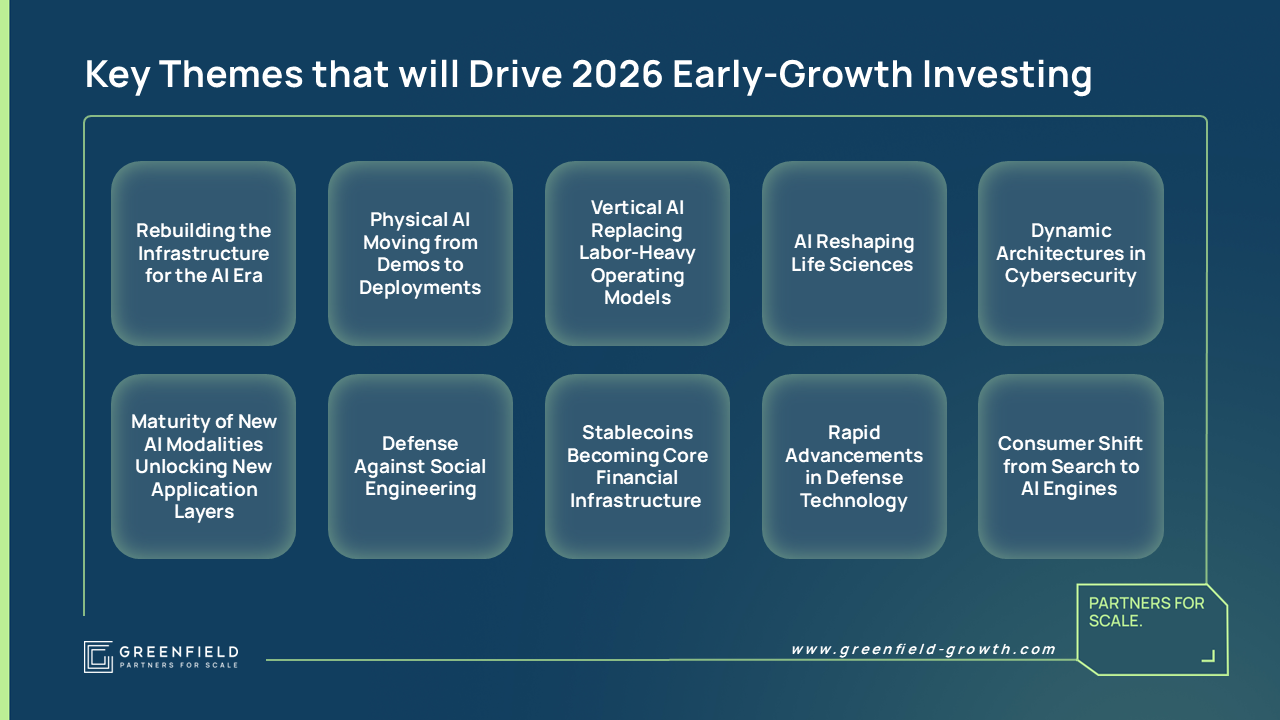
Theme #1: Rebuilding the Infrastructure for the AI Era
Foundation models are forcing a ground-up rebuild of infrastructure to enable safe, scalable AI adoption, spanning every layer of the stack. From power and compute, all the way up to optimized data storage and metadata management, advanced development platforms, and comprehensive security and governance frameworks.
This shift resembles prior infrastructure transitions like the move to cloud, but with two important differences. First, velocity. Cloud adoption unfolded over a decade, while AI infrastructure demands are materializing in compressed timeframes. Enterprises cannot simply bolt AI onto existing systems. They need purpose-built infrastructure designed for training, inference at scale, and AI governance. Second, the bottlenecks are increasingly physical rather than purely software-driven. Power availability, chips, and data center capacity are now central constraints, creating new categories of innovation.
Theme #2: Physical AI Moving from Demos to Deployments
AI is crossing from the digital world into the physical one. Machines can now perceive environments, make decisions, and act autonomously in unstructured, real-world settings.
We see strong opportunities in full-stack systems that combine foundation models with real-time perception and robotics to automate complex physical labor. AI is moving from labs into factories, warehouses, construction sites, and field operations.
As hardware costs decline and models improve, deployment is becoming economically viable at scale. The winners will be defined not by flashy demos, but by reliability, uptime, and cost efficiency. This is about production-grade systems that operate continuously in real environments.
Theme #3: Vertical AI Replacing Labor-Heavy Operating Models
Industries that skipped previous digitization waves are now leapfrogging directly to vertical AI solutions, replacing labor-intensive operating models across sectors including AEC, supply chain, pharma, real estate, and financial services.
AI is enabling true step-function improvements in industries that have operated on largely unchanged technology stacks for decades, automating workflows that once required deep domain expertise and manual effort. Success depends on solutions that deeply understand vertical-specific nuance.
The shift is not only technological, but also economic. We see two models emerging: AI platforms sold into existing service providers to expand margins and capacity without proportional headcount growth, and AI-native service providers built from the ground up to deliver outcomes that previously required large teams.
Theme #4: AI Reshaping Life Sciences
AI is transforming the entire biopharma value chain, from target discovery and R&D through clinical development, compressing timelines and costs while enabling therapeutic developments that were previously impossible.
A new generation of companies is emerging to build the infrastructure that will underpin the full realization of precision medicine. Beyond accelerating existing workflows, AI is fundamentally reshaping the economic models that have defined pharma for decades (massive upfront capital, lengthy development cycles, and blockbuster drug strategies to justify the investment). AI is enabling a shift toward more capital-efficient models and where previously "unprofitable" rare diseases or personalized medicine approaches become economically viable.
Theme #5: Dynamic Architectures in Cybersecurity
AI has fundamentally altered the threat landscape, making attacks faster, more sophisticated, and less predictable. Static, rules-based defenses are no longer sufficient.
We see a dual opportunity: first, building AI-native and adaptive architectures that evolve in real-time to counter sophisticated threats - systems that fight AI with AI; and second, solutions creating the security guardrails necessary to unlock safe enterprise AI adoption.
Theme #6: Defense Against Social Engineering
As we think about the risks and unintended consequences of AI, one emerging and increasingly material risk is AI-powered social engineering. Scenarios that once seemed like science fiction: AI-generated deepfakes impersonating a family member, a CEO, or a finance employee, are now technically trivial to execute and already causing significant losses. We believe this will become a top risk management priority in 2026.
Theme #7: Maturity of New AI Modalities Unlocking New Application Layers
AI is expanding beyond text into images, video, 3D, voice, simulations, and physical-world representations. These modalities unlock entirely new application layers.
In construction and design, AI can generate and iterate on 3D models. In gaming, it enables dynamic content and adaptive gameplay. In semiconductors, it optimizes chip layouts. In marketing, it powers personalized interactive experiences. In robotics, it allows machines to reason about complex environments.
Each modality does more than improve existing workflows. It makes new categories of applications possible. The winners will translate technical capability into durable business value.
Theme #8: Stablecoins Becoming Core Financial Infrastructure
Moving money across borders remains remarkably slow and expensive despite decades of technological advancement. Stablecoins are solving this problem by enabling instant, low-cost payments that can be embedded directly into business workflows.
Adoption is moving from pilots to production. Banks, payment providers, and corporates are embedding stablecoins into core treasury and payment workflows. A new financial stack is forming around settlement, compliance, and liquidity management.
Stablecoins also underpin emerging AI use cases, particularly agentic commerce, where AI systems require programmable, instant settlement to transact autonomously.
Theme #9: Rapid Advancements in Defense Technology
AI is fundamentally reshaping modern defense, shifting from human-in-the-loop platforms to autonomous, software-defined systems that can sense, decide, and act in real time. At the same time, the U.S., Europe, and NATO allies are materially expanding defense budgets and streamlining procurement, enabling faster adoption of next-generation technologies. Advances in autonomy, perception, edge compute, and simulation are unlocking new categories across drones, counter-drone, ISR, cyber-physical security, logistics, and command-and-control software. We believe this moment mirrors earlier enterprise software waves: rapid modernization, accelerated buyer behavior, and the emergence of a new generation of defense-native technology leaders defining the future of deterrence and resilience.
Theme #10: Consumer Shift from Search to AI Engines
Consumers are migrating from traditional search engines to conversational AI "answer engines" that understand intent and provide direct answers rather than links.
This shift unlocks two major opportunities. First, agentic commerce, where AI anticipates needs, evaluates options, negotiates, and executes transactions autonomously through multi-step reasoning aligned with user intent. Second, advertising in the AI era. As discovery moves from search queries to conversations, marketing spend will follow.
While market opportunity is crucial, GTM execution ultimately determines category leadership.
Over the past couple of years, we've been closely following companies across these themes as they've evolved from their initial seed rounds into more mature businesses now approaching the early-growth stage. At this inflection point, post product-market fit, GTM execution becomes the key differentiator determining which companies emerge as category leaders and fully capitalize on the opportunity ahead.
The transition from product–market fit to scalable growth is where most venture-backed companies stall as they fail to industrialize GTM. In the AI era, where technology advantages are harder to defend over time, GTM excellence has become increasingly critical.
At Greenfield, our fund is purpose-built to help companies navigate this inflection point. We work with our portfolio to systematically industrialize GTM early, increasing the odds of efficient scale and helping teams avoid costly cycles. Our approach is grounded in the Seven Pillars of Efficient Growth: Strategy, Operational Framework, People, Pipeline, Sales Process, Partnerships, and Account Management. By putting the right GTM infrastructure in place early, companies can unlock rapid, capital-efficient growth on the path to durable scale.
We are excited to partner with teams that are actively building their GTM organizations and looking for a hands-on partner to support that journey. We have seen this journey firsthand. Multiple companies in our portfolio were at single-digit ARR when we invested and are now approaching or surpassing $100M in ARR, with a clear line of sight to $1B. This is exactly what our G2M (Greenfield Growth Momentum) program was built to support.